
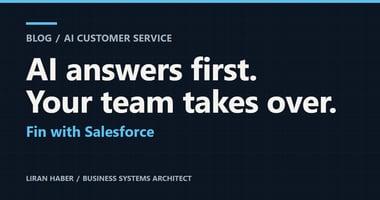
Quick answer: Fin, the AI agent Salesforce acquired in September 2026, answers customers from your...
Choosing an AI agent for customer service: Fin or Agentforce?
Quick answer: Choose Fin if you want AI answering customers from your help content within weeks, billed only for results ($0.99 per resolved conversation as of September 2026). Choose Agentforce if you're deep in Salesforce and want the AI to act inside your processes, such as updating records, and have the Salesforce expertise to build and maintain it.
You've decided AI should take on part of your customer service. Now there's a choice that became more interesting in September 2026, when Salesforce completed its acquisition of Fin: two AI agents from the same company, Fin and Agentforce. Which one fits your business?
They're built for different jobs, and they're paid for in different ways. Here's how I'd decide.
Start with the job, not the product
Three questions settle most of the decision:
- What should the AI do? Answer customers' questions from your help content, or also take actions in your systems, such as changing a booking, updating an order or starting a refund?
- Where do your team and your data live? Entirely in Salesforce, or across a helpdesk and other systems?
- How fast do you need results, and who will run it? A dedicated Salesforce team can build and maintain deep automation. A lean team needs something that works quickly with little upkeep.
Fin: quick to launch, paid for by results
Fin answers customers from your own help content, around the clock, and hands over to your team when it should. Salesforce describes it as a fast-to-deploy AI agent that works with the help desks and systems companies already use, and it connects directly to Salesforce. I've written about how Fin hands conversations over to a Salesforce team.
Best for: taking routine questions off your team's plate within weeks, with a cost that follows results.
Agentforce: built into Salesforce, for deeper work
Agentforce is Salesforce's own AI agent platform. It works directly on your Salesforce data and processes, so it can do more than answer: update records, run your automated processes and carry out multi-step tasks. Salesforce positions it for deeply tailored, enterprise-scale work.
Best for: businesses already deep in Salesforce that want the AI to act inside their processes, and have the Salesforce expertise to build and maintain it.
What it costs: one bills results, the other bills activity
This is the difference owners care about most. Prices as of September 2026:
- Fin: $0.99 per conversation it resolves on its own. Conversations handed to your team cost nothing, you're charged at most once per conversation, and a resolution is taken off the bill if the customer comes back for more help. The minimum is $49 a month, and there's a free 14-day trial.
- Agentforce: you pay for the AI's activity. Either $0.10 per action, bought as credits ($500 for 100,000 credits, 20 credits per standard action), or $2 per customer conversation. An action is a single task the AI performs, such as answering a question or updating a record. You can pay as you go, and Salesforce's Digital Wallet shows usage in near real time, with alerts before you pass a threshold. Salesforce also sells per-user editions.
Here's what that means in a real month. Say you have 1,000 customer conversations, and the AI resolves 600 of them on its own:
- Fin: 600 resolutions × $0.99 = about $594. The 400 handed to your team cost nothing.
- Agentforce, per action: it depends on how many actions each conversation takes. At four actions per conversation, about $400; at ten, about $1,000.
- Agentforce, per conversation: 1,000 × $2 = $2,000.
Neither is cheap or expensive by default. Fin's bill tracks the problems it actually solves. Agentforce's bill tracks how much work the AI does, which pays off when that work replaces manual steps inside Salesforce. Either way, you can start small and see exactly what you're paying for before you commit to more.
Why companies choose Fin over Agentforce, and when they shouldn't
When a business picks Fin first, or moves its customer service AI from Agentforce to Fin, it's usually for one of these reasons:
- The bill follows results. You pay for conversations the AI actually solves, so the cost is easy to compare with the team time it saves.
- Weeks, not a build project. Fin learns from the help content you already have, so it can start answering customers quickly.
- No move required. It works with the help desk your team already uses, whether or not that's Salesforce.
- Less upkeep. A lean team can run it without dedicated Salesforce developers.
Agentforce remains the better fit when the AI has to do real work inside Salesforce, such as changing orders, updating records or running your approval steps, and you have the Salesforce team to build and look after it. Switching away from that kind of setup only to save on the bill usually costs more than it saves.
How I'd choose
- Mostly questions, answered from your help content, and you want results in weeks: Fin.
- The AI must take many actions inside Salesforce, and you have a Salesforce team: Agentforce.
- Not sure yet: run a small pilot with Fin on one channel, which is quick to set up and paid by results, while you map the tasks you'd eventually want automated inside Salesforce. That map tells you whether Agentforce is worth the build.
Common questions
Now that Salesforce owns both, will one of them disappear?
Salesforce says Fin will continue to serve its customers and develop its AI agent, alongside Agentforce, giving businesses more choice. Nobody can promise the long term, which is one more reason to start with a pilot that doesn't lock you in.
Do we need Salesforce to use Fin?
No. Fin also works with other help desks. If you do use Salesforce, Fin connects to it directly.
Can we start small?
Yes. Fin has a free 14-day trial and a $49 monthly minimum. Agentforce can be bought pay as you go.
Is Agentforce the same as Salesforce Einstein?
Agentforce is the current name for Salesforce's AI agents. Salesforce renamed Einstein Copilot to Agentforce in early 2025. If you're comparing Fin with Salesforce Einstein for customer service, Agentforce is the product to compare it with today.
Is Fin cheaper than hiring another support agent?
For routine questions, usually yes. At $0.99 per resolved conversation, 1,000 resolutions a month cost about $990, well below the cost of a full-time hire in most countries. But it only takes the routine work: your team still handles everything the AI hands over, so think of it as freeing your people for the conversations that need them, not replacing them.
Will the AI say the wrong thing to customers?
With either product, you decide what the AI may handle and when it hands over to a person. Getting those rules right matters more than which product you pick.
Choosing between them is mostly about your processes, not the software. I help businesses decide what the AI should handle, choose the right tool and connect it to their systems, so your team sees everything in one place. Tell me what you want to improve.